Buying a Business vs Starting One From Scratch
Most people who want to work for themselves default to starting something. It is the version of the story we are told, and it costs almost nothing to begin. Buying a business rarely enters the conversation, usually because people assume it requires money they do not have.
That assumption is worth examining, because the two paths carry completely different risks and the one that sounds safer often is not.
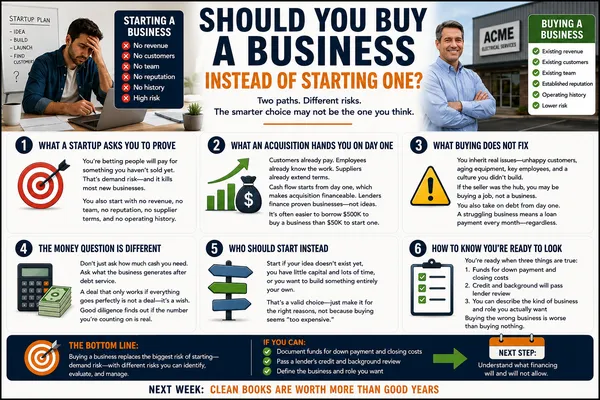
What a startup asks you to prove
When you start from zero, you are betting that enough people will pay you enough money for something you have not sold yet. That is demand risk, and it is the risk that kills most new businesses. You can be excellent at the work and still not find enough customers before you run out of runway.
You also start with no revenue, no team, no reputation, no supplier terms, and no operating history. Every one of those has to be built while you are also doing the work and covering your personal expenses.
What an acquisition hands you on day one
When you buy an established business, demand risk is largely answered. Customers already pay. Employees already know how the work gets done. Suppliers already extend terms. There is a phone number people already call.
The practical version of this is cash flow. A profitable business generates income the first month you own it, which is what makes acquisition financeable in a way a startup usually is not. A lender will finance the purchase of a business with a track record of servicing debt. That same lender will not finance your idea.
This is the part most first time buyers miss. It is often easier to borrow several hundred thousand dollars to buy a business that already makes money than to borrow fifty thousand to start one that does not.
What buying does not fix
An acquisition trades demand risk for a different set of risks, and pretending otherwise sets buyers up badly.
You inherit whatever is actually there, including the customer who is unhappy, the equipment nearing the end of its life, and the long tenured employee who was loyal to the seller and is not yet loyal to you. You inherit a culture you did not build. If the seller was the hub that everything ran through, you may be buying a job rather than a business, and you will feel that within sixty days.
You also take on debt from day one. A startup that struggles costs you time and savings. An acquisition that struggles costs you a loan payment every month regardless.
The money question is different than people think
Buyers usually ask how much cash they need and stop there. The better question is what the business generates after debt service, and whether that number supports your household while leaving room for the business to breathe.
A deal that pencils only if everything goes perfectly is not a deal, it is a wish. Good diligence is mostly the work of finding out whether the number you are counting on is real.
Who should start instead
Buying is not the right answer for everyone. If your idea genuinely does not exist in the market yet, there is nothing to buy. If you have very little capital and a lot of time, starting may fit your situation better. And if you want to build something entirely your own from the ground up, that is a legitimate reason, as long as you name it as a preference rather than a financial argument.
How to know you are ready to look
You are ready to look at acquisitions when three things are true. You can document funds for a down payment and closing costs. Your credit and background will survive a lender's review. And you can describe, in a sentence, the kind of business and the kind of role you actually want, because buying the wrong business is far worse than buying nothing.
If you can do those three things, the next step is not browsing listings. It is understanding what financing will and will not allow, which is where we are headed next week.
If you are weighing whether to buy or build, book a call and we will talk through what your situation can actually support.