Why Most Owners Wait Too Long to Sell
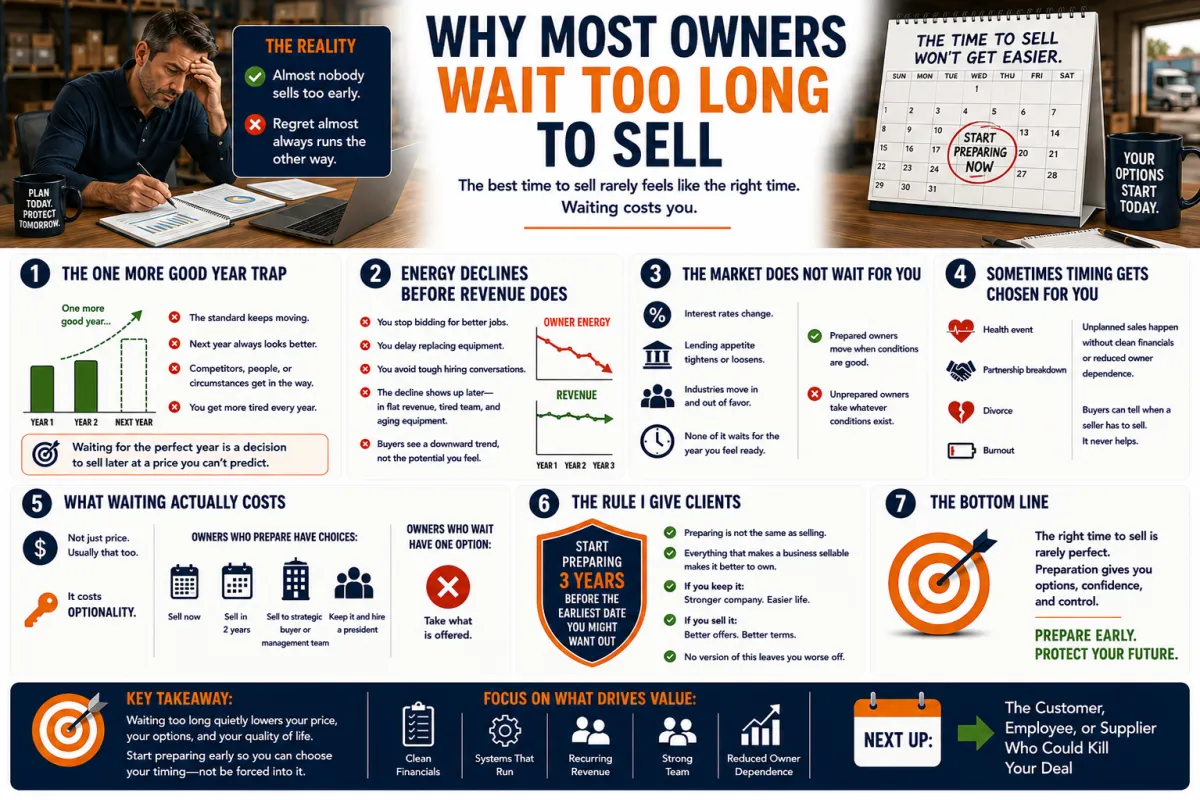
Almost nobody sells too early. In years of these conversations, I can count on one hand the owners who looked back and wished they had waited. The regret runs almost entirely the other direction.
What is interesting is that waiting too long is rarely a decision. Nobody sits down and chooses to hold on past the right moment. It happens through a series of individually reasonable delays.
The one more good year trap
The most common version goes like this. The business is performing. An owner starts thinking about selling, runs some numbers, and concludes that one more strong year would meaningfully raise the price. Which is often true.
So he waits. And the next year is fine, but not the year he imagined, because a competitor got aggressive or a key employee left or the weather did what it does. So he waits again, now needing a good year to make up for the flat one.
The trap is that the standard keeps moving. There is always a reason next year looks better than this year, and there is always a version of the business that would sell for more than the one you have today. Waiting for that version is a decision to sell later at a price you cannot predict, made by someone who is getting more tired every year.
Energy declines before revenue does
Here is the pattern that catches people. Owner energy almost always drops before the numbers do, sometimes by years.
You stop bidding for jobs that stretch you. You put off replacing the truck. You do not have the hiring conversation you know you need to have. None of it shows up in the P and L right away. It shows up two and three years later, in flat revenue and a tired team and equipment nearing the end of its life.
By the time the decline is visible in the financials, the buyer sees a business trending down. The price reflects the trend, not the potential you know is still there.
The market does not wait for you
Your readiness to sell and the market's willingness to pay are two independent variables that happen to matter at the same time.
Interest rates change what a buyer can borrow against your cash flow. Lending appetite tightens and loosens. Your industry moves in and out of favor. None of that is under your control, and none of it waits for the year you finally feel ready.
Owners who are prepared can move when conditions are good. Owners who are not prepared take whatever conditions exist on the day circumstances force their hand.
And sometimes the timing gets chosen for you
The sales that go worst are the ones that were not planned at all. A health event, a partnership that breaks down, a divorce, a burnout that arrives all at once instead of gradually.
In every one of those, the owner is selling on someone else's schedule, usually without the three years of clean financials and reduced owner dependence that would have protected the price. Buyers can tell when a seller has to sell, and it never helps.
What waiting actually costs
Not just price, though usually that too. It costs optionality.
An owner who prepared has choices: sell now, sell in two years, sell to a strategic buyer or to the management team, or keep it and hire a president. An owner who waited until they were done has one option, which is to take what is offered.
The rule I give clients
Start preparing three years before the earliest date you might want out. Not three years before you are certain, three years before it is even possible.
Preparing is not the same as selling. Everything that makes a business sellable, clean books, systems that run without you, revenue that repeats, a team that can carry it, also makes the business better to own. If you decide to keep it, you have a stronger company and a life that is easier to live. If you decide to sell, you are ready.
That asymmetry is the whole argument. There is no version of this where preparing early leaves you worse off.
If you are anywhere in that three year window, book a strategy session and we will look at where you actually stand.
Book a complementary strategy session here!