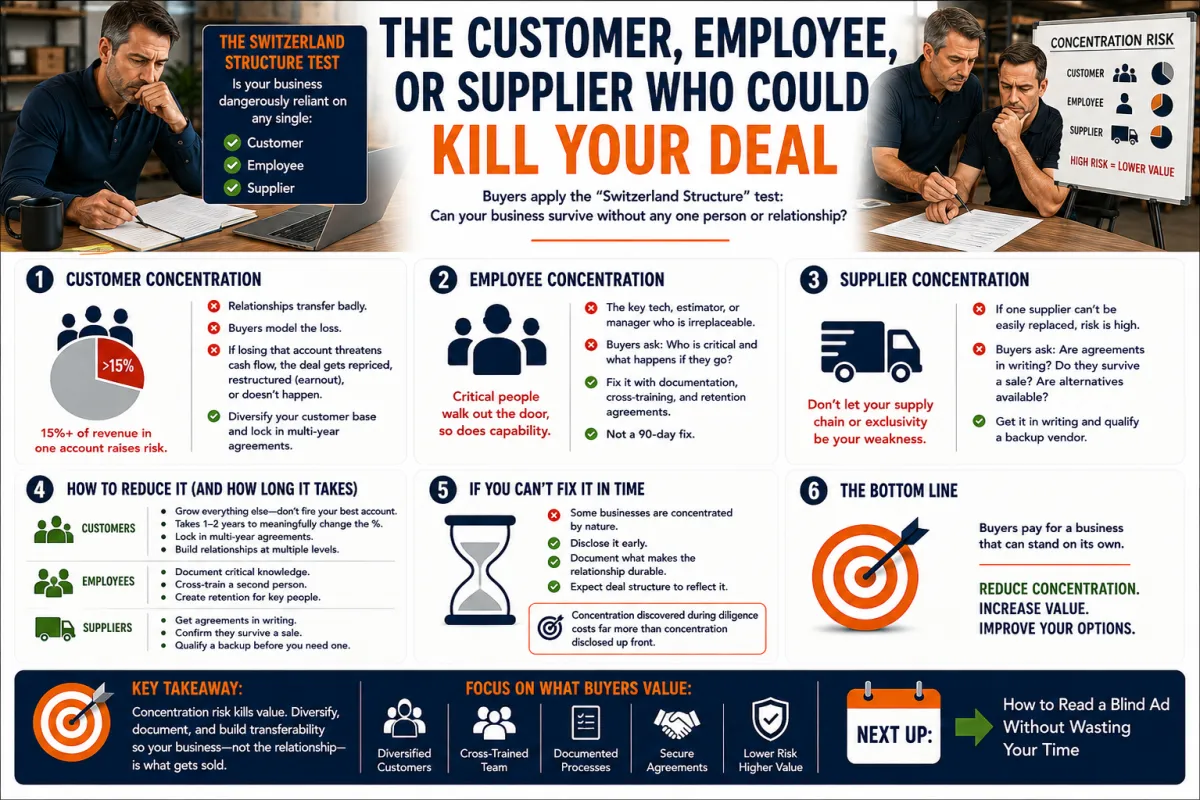
The Key Customer, Employee, or Supplier Who Could Kill Your Deal
Owners are usually proud of their biggest account. It took years to win, it is a name people recognize, and it pays reliably. So it comes as a genuine surprise when a buyer treats it as a problem.
The driver behind that reaction is called Switzerland Structure, named for the country famous for depending on nobody. The question it asks is whether your business is dangerously reliant on any single customer, employee, or supplier. All three count, and owners usually only think about the first.
Customer concentration
The concern gets serious somewhere around fifteen percent of revenue in one account and becomes a real problem well before you hit a third. The exact threshold varies by industry and by how the relationship is structured, but the logic does not change: the more revenue sits in one relationship, the more the buyer is purchasing that relationship rather than your business.
And relationships transfer badly. The account may be loyal to you personally. Their buyer may retire. They may have their own reasons to reassess vendors when ownership changes, and a transition is exactly the moment they will look around.
A buyer models the loss. If losing that account would take the business below the point where it covers debt service, the deal either gets repriced, gets restructured so you carry the risk through an earnout, or does not happen.
Employee concentration
This one is quieter and often worse. It is the technician who is the only one who can run the specialty equipment. The estimator whose numbers are right in a way nobody can explain. The service manager every long term customer asks for by name.
If that person leaves during or shortly after the transition, capability walks out with them. Buyers know it, which is why they ask who is critical and what happens if they go.
The fix is documentation and cross-training, which is exactly what the Operations and Training Manual is for, plus retention arrangements that give key people a reason to stay through a transition. Both take time, which is why this is not a ninety day fix.
Supplier concentration
The least discussed of the three. If one supplier provides something you cannot readily source elsewhere, or you hold an exclusive that could be pulled, your cost structure and delivery capability sit in someone else's hands.
Buyers ask whether supply agreements are in writing, whether they survive a change of ownership, and whether alternatives exist. Answering yes, no problem, off the top of your head is not the same as showing them a second qualified vendor you already buy from.
How to reduce it, and how long it takes
For customers, the honest answer is that you reduce concentration by growing everything else, not by firing your best account. That means a deliberate push on customer acquisition, which takes a year or two to change the percentages meaningfully.
You can also change the shape of the risk faster than you can change the numbers. A signed multi-year agreement is worth far more to a buyer than an equally large handshake relationship. Building relationships at multiple levels inside that customer, rather than one person to one person, makes the account transferable in a way it was not before.
For employees, document the critical knowledge and cross-train a second person, then formalize retention for the people who genuinely cannot be replaced quickly.
For suppliers, get agreements in writing, confirm they survive a sale, and qualify a backup before you need one.
If you cannot fix it in time
Some businesses are concentrated by nature and no amount of planning changes that. In that case, do not hide it. Disclose it early, document everything that makes the relationship durable, and expect the deal structure to reflect it.
Concentration discovered during diligence costs far more than concentration disclosed up front, because the first one makes a buyer wonder what else you did not mention.
If you are not sure where your concentration risk actually sits, stop guessing and click here to take the complementary ValueBuilder™ Questionnaire!