SBA Loans for Buying a Business: What Lenders Require
Most buyers of small businesses use SBA financing, and most first time buyers discover the rules one painful surprise at a time. It is worth understanding the structure before you fall in love with a listing, because financing shapes what you can buy far more than preference does.
What follows reflects the SBA's current standard operating procedure for 7(a) lending, which took effect June 1, 2025. Rules change, lenders layer their own requirements on top, and nothing here is a substitute for a conversation with an actual underwriter.
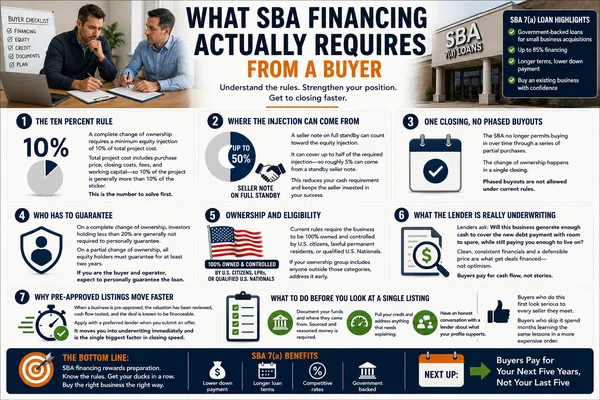
The ten percent rule
A complete change of ownership requires a minimum equity injection of ten percent of total project cost. Total project cost is not just the purchase price. It includes closing costs, fees, and working capital, so ten percent of the project is generally more than ten percent of the sticker.
This is the number that stops most casual buyers, and it is the number to solve first.
Where the injection can come from
It does not all have to be your cash. A seller note can count toward the equity injection if it is on full standby for the life of the SBA loan, meaning no principal and no interest paid to the seller until the SBA loan is retired. That standby portion can cover up to half of the required injection, so on a ten percent requirement, roughly five percent can come from a standby seller note.
That structure matters for two reasons. It reduces the cash you have to bring, and it keeps the seller financially invested in your success, which is a signal buyers should want and sellers should be willing to give.
One closing, no phased buyouts
The SBA no longer permits buying in over time through a series of partial purchases. The change of ownership happens in a single closing. If you were hoping to buy a piece now and the rest later out of cash flow, that path is closed under current rules.
Who has to guarantee
On a complete change of ownership, investors holding less than twenty percent are generally not required to personally guarantee. On a partial change of ownership the rules are stricter, with all equity holders guaranteeing for at least two years, which has largely eliminated seller rollover equity as a practical structure.
In plain terms: if you are the buyer and operator, expect to personally guarantee the loan. That is the deal.
Ownership and eligibility
Current rules require the business to be one hundred percent owned and controlled by US citizens, lawful permanent residents, or qualified US Nationals. If your ownership group includes anyone outside those categories, address it before you spend months on a transaction.
What the lender is really underwriting
Underneath the checklist, the lender is answering one question: does this business generate enough cash to cover the new debt payment with room to spare, while still paying you enough to live on?
That is why a business with owner add-backs nobody can verify is hard to finance, and why a business with clean, consistent statements moves quickly. It is also why the purchase price has to be defensible. A lender is not obligated to finance an enthusiastic buyer's opinion of value.
Why pre-approved listings move faster
When a business has already been through lender review before it goes to market, the buyer is not waiting to find out whether the deal is financeable. The valuation has been examined, the cash flow has been tested, and the remaining question is you rather than the business.
This is why I ask buyers to apply with at least one preferred lender at the time they submit an offer to purchase. It moves you into underwriting immediately rather than starting the clock after everyone has already agreed on terms, and it is the single biggest factor in how fast a deal reaches closing.
What to do before you look at a single listing
Three things. Document your available funds and where they came from, because sourced and seasoned money is a requirement, not a formality. Pull your credit and address anything that needs explaining. And have an honest conversation with a lender about what your profile supports, so you are shopping in the right range instead of falling for businesses you cannot finance.
Buyers who do this first look serious to every seller they meet. Buyers who skip it spend months learning the same lessons in a more expensive order.
If you want to understand what your situation can actually finance, book a call and we will map it out before you start looking.
Book a complementary strategy session HERE