Recurring Revenue: Contracts in a Service Business
Ask an owner whether they have recurring revenue and most say yes. Ask what it consists of and the answer is usually that customers come back. Those are not the same thing, and the distinction is worth real money.
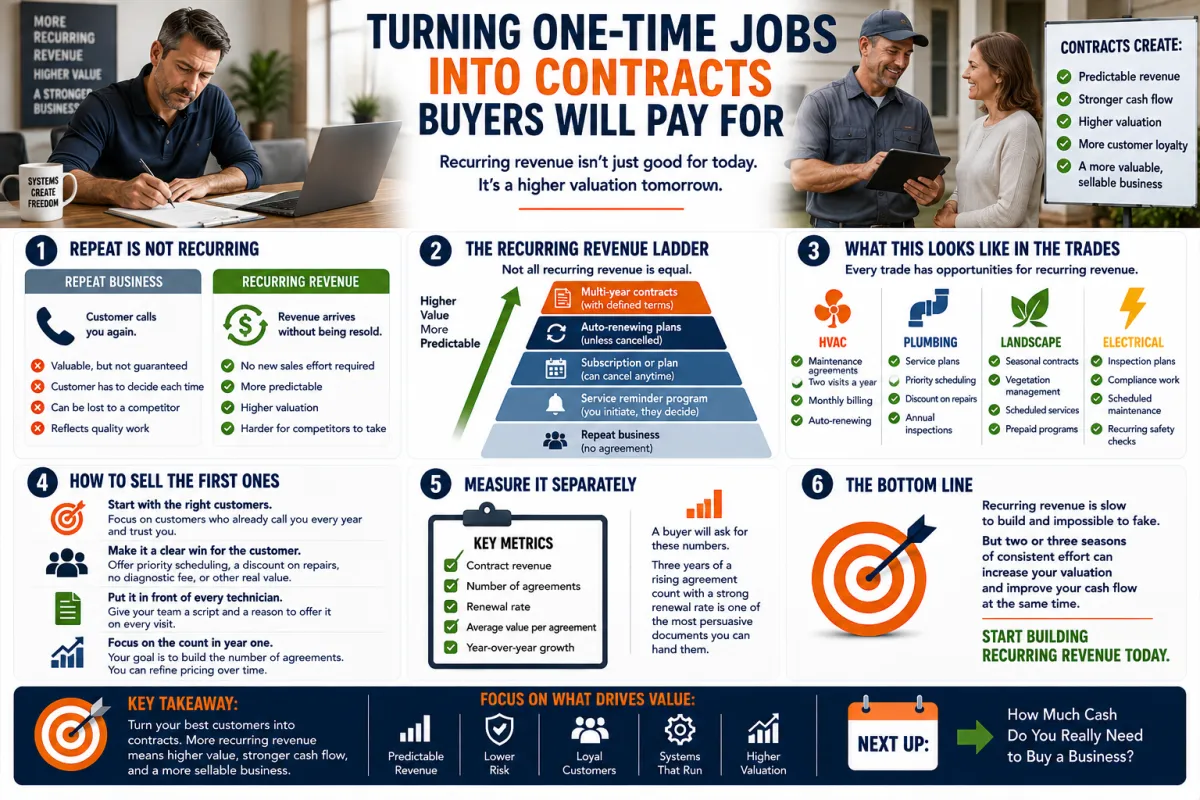
Repeat is not recurring
A customer who calls you every spring because they have always called you is repeat business. It is valuable, it reflects well on your work, and it is a habit that can be broken by a coupon, a bad experience, or a competitor who happens to call first.
Recurring revenue is revenue that arrives without being resold. Nobody has to make a decision for it to continue. That difference in predictability is why buyers pay more for it, and why it does more for your valuation than an equivalent amount of transactional work.
The ladder
Not all recurring revenue carries the same weight, and it helps to think of it as a ladder from weakest to strongest.
At the bottom is genuine repeat business with no agreement. Above that, a customer list on a service reminder program, where you initiate contact but they decide each time. Above that, a subscription or plan they signed up for and can cancel any time. Higher still, a plan that automatically renews unless cancelled, because inertia now works for you instead of against you. At the top, multi-year contracts with defined terms.
Moving customers up even one rung changes what the revenue is worth. And most service businesses have customers sitting at the bottom of that ladder who would happily be higher if anyone had asked.
What this looks like in the trades
In HVAC it is the maintenance agreement, two visits a year, billed monthly, auto-renewing. In plumbing it is a service plan with priority scheduling and a discount on repairs. In landscape and vegetation management it is the seasonal contract signed in advance rather than the spring phone call. In electrical and specialty trades it is scheduled inspection and compliance work, which customers frequently need on a fixed cycle whether or not anyone is selling it to them.
The pattern is consistent. Somewhere in your work there is something the customer needs predictably. The only question is whether you have packaged it.
How to sell the first ones
Start with the customers who already behave as if they are on a plan. They call you every year, they never shop for it, they trust you. Those people are not being asked to change anything, only to formalize what they already do, and the conversion rate on that conversation is far higher than owners expect.
Price it so the customer clearly wins. Priority scheduling, a discount on repairs, no diagnostic fee, whatever costs you little and matters to them. The goal in year one is not margin on the plan, it is the count of agreements.
Then put it in front of every technician at every visit, with a script and a reason to offer it. This is where most programs quietly fail. Not because customers say no, but because nobody consistently asks.
Measure it separately
Track contract revenue as its own line, along with how many agreements you hold, your renewal rate, and what an agreement is worth annually. A buyer will ask for exactly these numbers, and being able to show three years of a rising agreement count with a strong renewal rate is one of the more persuasive documents you can hand them.
Why this one is worth starting today
Recurring revenue is slow to build and impossible to fake. You cannot add two hundred maintenance agreements in the quarter before you sell. But two or three seasons of consistent effort can genuinely change the composition of your revenue, and it is one of the few improvements that raises your price and your day to day cash flow at the same time.
Want to lean more about building recurring revenue in your business? Click here to get my Free eBook, The Subscription Economy: Nine subscription models any business can adopt.