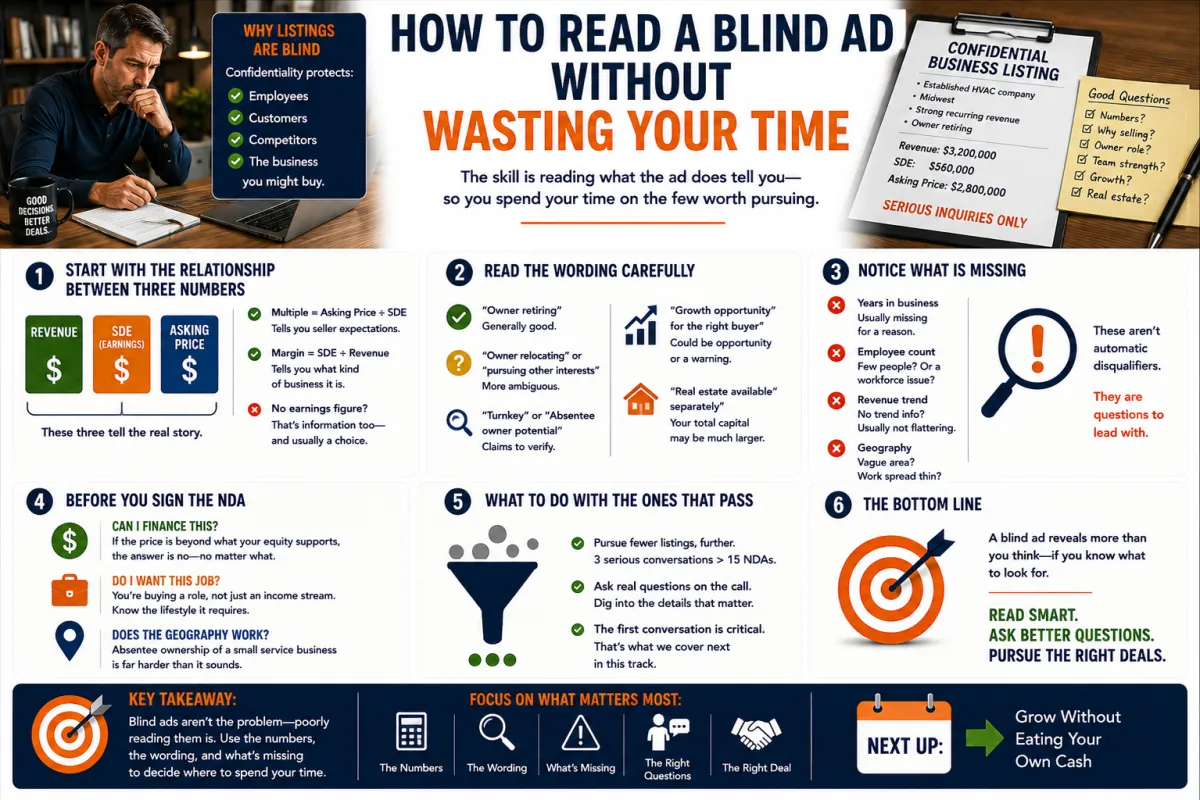
How to Read a Blind Ad Without Wasting Your Time
Business listings are deliberately vague. Established HVAC company, Midwest, strong recurring revenue, owner retiring. No name, no address, sometimes not even a city.
New buyers find this frustrating and assume the seller is hiding something. Usually the opposite is true. The listing is blind because the seller has employees who do not know, customers who would worry, and competitors who would use the information. Confidentiality is protecting a business you might end up buying.
The skill worth developing is reading what the ad does tell you, so you spend your time on the few worth pursuing.
Start with the relationship between three numbers
Most listings give you revenue, some measure of earnings, usually seller's discretionary earnings, and an asking price. Those three together tell you more than any of them alone.
Divide the asking price by SDE. That is the multiple, and it tells you roughly where the seller's expectations sit. Compare SDE to revenue for the margin, which tells you what kind of business this is. A high revenue, thin margin business is a very different job than a smaller, richer one, even at the same price.
If the ad gives revenue and price but no earnings figure at all, that is information too. Earnings is the number buyers care about most, so leaving it out is usually a choice rather than an oversight.
Read the wording carefully
Certain phrases are doing real work.
Owner retiring is generally good, because it suggests a timeline and a motivation that has nothing to do with the business declining. Owner relocating or pursuing other interests is more ambiguous and worth asking about directly.
Turnkey operation and absentee owner potential are claims to verify rather than facts, and they are the exact claims that fall apart in diligence most often. Growth opportunity for the right buyer often means the current owner has been coasting, which can be a genuine opportunity or a warning depending on why.
Real estate available separately matters more than it looks. It means your total capital requirement may be much larger than the asking price, or that you will have a landlord relationship with the person you just bought from.
Notice what is missing
Years in business, employee count, and whether revenue is trending up or down are the three most common omissions, and each one is usually left out for a reason.
No employee count on a business of meaningful size often means either very few people, which raises the owner dependence question immediately, or a workforce issue. No trend information usually means the trend is not flattering. A vague geography on a service business can mean the work is spread thin over a wide area, which affects margins.
None of these are automatic disqualifiers. They are the questions to lead with.
Before you sign the NDA
Signing costs you nothing but time, and time is the resource new buyers waste most. Ask yourself three things first.
Can I finance this? If the asking price is well beyond what your equity injection supports, the answer is no regardless of how good the business looks.
Do I want this job? You are buying a role, not just an income stream. A business that requires you on job sites at six in the morning is a different life than one run from an office, and the listing usually hints at which it is.
Does the geography work? Absentee ownership of a small service business is far harder than it sounds. If you cannot be there regularly, be honest about that now.
What to do with the ones that pass
Pursue fewer listings, further. Buyers who sign fifteen NDAs and skim fifteen packages learn less than buyers who pursue three seriously and ask real questions on the call.
Which brings up the part most buyers underprepare for: the first conversation with the seller. That is next in this track.
If you want a second set of eyes on a listing you are considering, book a call and we will read it together.