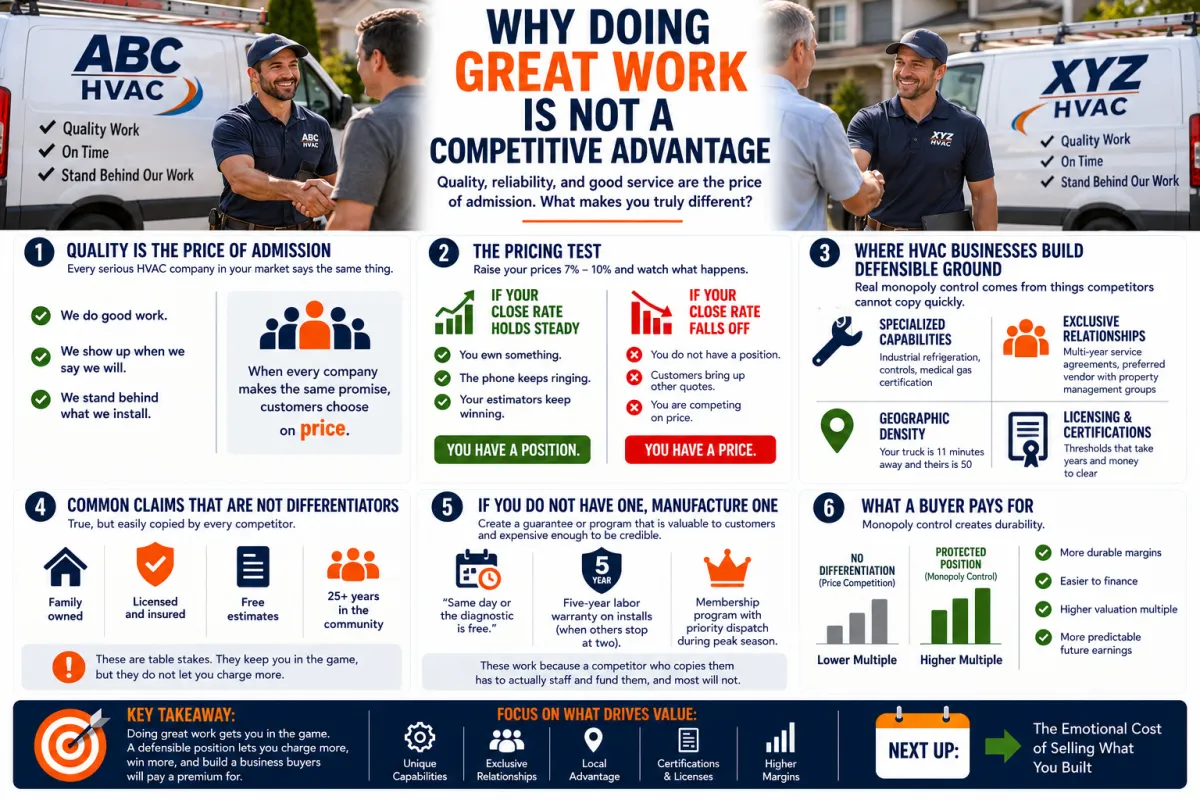
Why Doing Great Work Is Not a Competitive Advantage
Ask an HVAC owner what makes his company different and you will hear a version of the same three sentences. "We do good work." "We show up when we say we will." "We stand behind what we install."
I believe him every time. The trouble is that the HVAC company two exits up the highway says the same thing, in nearly the same words, on a website built by the same marketing shop. When two companies make an identical promise, the customer has exactly one way left to choose between them, and that way is price.
Value Driver 6 is Monopoly Control, and it asks an uncomfortable question. What do you have that a competitor cannot copy by next quarter if they decide to try?
Quality is the price of admission, not a position
Quality workmanship is not a differentiator in the trades. It is the minimum standard for staying in business, and every serious competitor in your market has it too. The ones who do not have it are not who you lose bids to anyway.
The same goes for most of what owners put on the truck wrap. "Family owned." "Licensed and insured." "Free estimates." "Twenty-five years in the community." All of that is true, and none of it makes a homeowner pay you eighteen percent more than the guy who quoted yesterday.
The pricing test tells you the truth in about ninety days
Here is the cleanest test of whether you actually have monopoly control. Raise your prices somewhere between seven and ten percent and watch what happens to your close rate.
If the phone keeps ringing and your estimators keep winning at roughly the same rate, you own something. If the close rate falls off a cliff and your techs start hearing about the other quote on every call, you do not have a position. You have a price. Most owners are afraid to run this test, which tells you something on its own.
Where trades businesses actually build defensible ground
Real monopoly control in this industry usually comes from one of a few places, and almost never from being nicer.
A technical capability the competition does not staff for, like industrial refrigeration, controls work, or medical gas certification.
A customer relationship structure others cannot get at, such as multi-year service agreements or a preferred vendor slot with a property management group.
A geographic density advantage, where your truck is eleven minutes away and theirs is fifty.
A licensing, bonding, or certification threshold that takes years and money to clear.
Notice that each of these is a thing you built or earned, not a thing you claim. A competitor reading your website cannot acquire any of them this year.
If you do not have one, manufacture one
Most owners in the $3M to $10M range do not have a natural monopoly. That is fine. You can build one deliberately, and the fastest route is usually a guarantee or a program that is expensive enough to be credible and specific enough to be checkable.
"Same day or the diagnostic is free." A written five-year labor warranty on installs when nobody else in the county goes past two. A membership program that includes priority dispatch during the first heat wave of the summer, when priority is the only thing anybody wants. These work because a competitor who copies them has to actually staff and fund them, and most will not.
What a buyer pays for when you have it
A buyer looks at monopoly control as durability. Gross margin that has held through three busy seasons and one bad one says the pricing is anchored to something other than luck. Margin that erodes every time a new competitor opens says the opposite.
This is also why monopoly control shows up in the multiple rather than just the earnings. Two companies can both show a million in adjusted earnings, and the one with a protected position gets financed more easily and sells for more, because the buyer believes next year looks like this year.
Next in the driver series we move from what protects your pricing to what protects your revenue, and look at how measured customer loyalty becomes an asset a buyer can verify rather than a story you tell.
If you are not sure whether you have a real position or just a good reputation, book a strategy session and we will run your pricing and margin history to find out.