If You Left for 90 Days, Would Revenue Survive?
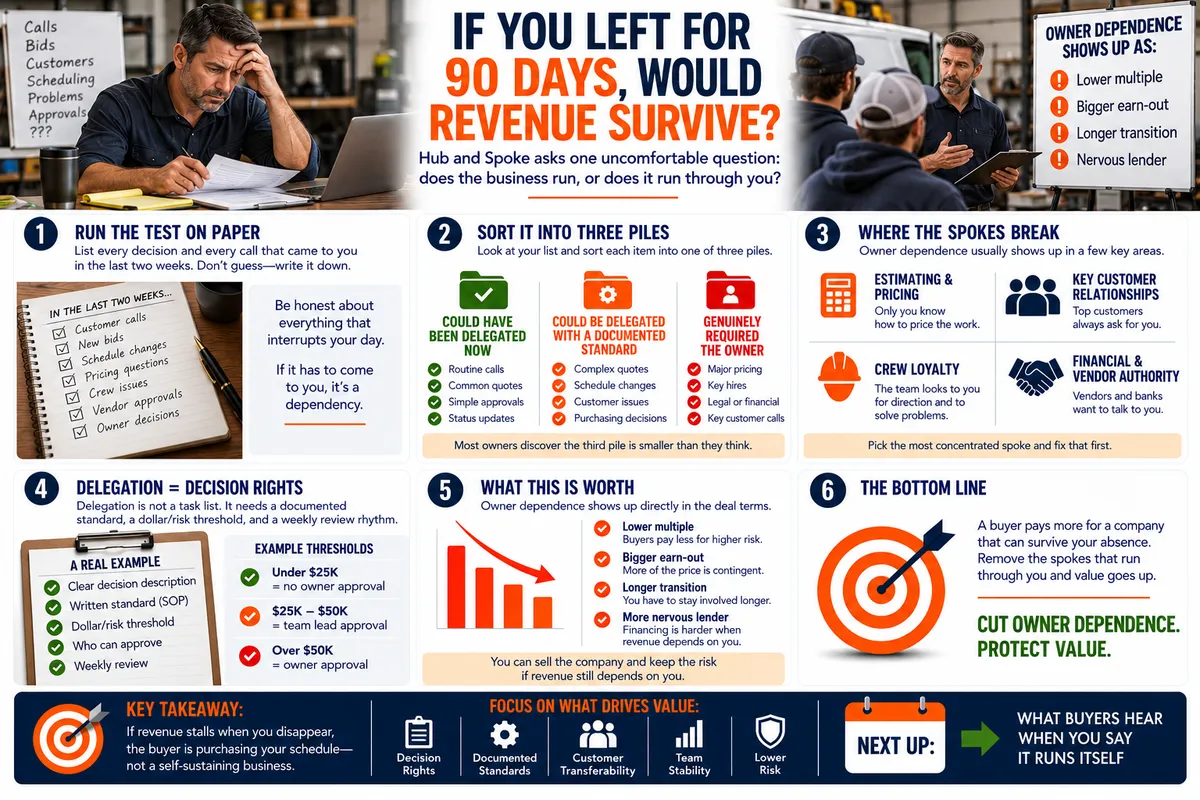
Take a vacation and answer honestly. Not a long weekend where you check email from the lake. Ninety days, phone off, nobody calls you.
Most owners in this industry cannot get through week two. The bid on the school district job needs a decision. A customer who only deals with you is unhappy. The bank wants a signature. Two techs are threatening to quit and you are the only one they will talk to.
That is Value Driver 8, Hub and Spoke, and it is the last of the eight because it quietly determines how much the other seven are worth. A company with strong financials and a dependent owner still sells at a discount, because the buyer is not purchasing a company; they are purchasing your schedule.
Run the test on paper before you run it for real
You do not need to disappear for a quarter to learn what you need to know. Take the last two weeks and write down every decision that came to you and every call that only you could take.
Then sort them into three piles. Decisions someone else could have made with the information available. Decisions someone else could have made if they had a documented standard. Decisions that genuinely required the owner.
In most companies the third pile is much smaller than the owner expects, and most of it is signature authority rather than judgment. That is good news, because the first two piles are fixable in months, not years.
Where the spokes actually break in trades businesses
Owner dependence is not one problem. It is usually four, and they need different fixes.
Estimating and pricing, where the owner carries the numbers in his head and nobody else is trusted to bid over a certain size.
Key customer relationships, especially general contractors and property managers who call your cell directly.
Crew loyalty, where the good techs stay because of you personally and everyone knows it.
Financial and vendor authority, including bonding, credit lines, and supply house terms tied to your personal guarantee and relationships.
Pick the one that is most concentrated and work it first. Trying to fix all four at once is how owners end up fixing none.
Delegation means decision rights, not task lists
Owners tell me they have delegated estimating, and then it turns out the estimator builds the bid and the owner approves every one. That is not delegation. It is a longer approval chain with the same single point of failure.
Real delegation has three parts: a documented standard so the decision can be made the way you would make it, a dollar or risk threshold that defines where authority ends, and a review rhythm that catches problems weekly instead of instantly.
Start with a threshold you are comfortable with, even if it feels low. Every bid under twenty-five thousand goes out without you. Raise it each quarter as the results come in. The point is to build a track record, for them and for you.
What this is worth in real dollars
I will not give you a number, because it varies by deal, but the direction is never in question. Owner dependence shows up as a lower multiple, a bigger earn-out, a longer required transition period, and a more nervous lender.
The earn-out and the transition terms matter more than owners expect. A buyer who believes the business needs you may still buy it, but they will structure the deal so that a meaningful piece of your money depends on performance after you leave. You will have sold the company and kept the risk.
The end of the eight drivers, and what comes next
That closes the arc. Financial Performance, Growth Potential, Switzerland Structure, the Valuation Teeter-Totter, Recurring Revenue, Monopoly Control, Customer Satisfaction, and Hub and Spoke. Together they explain most of the gap between two companies with identical revenue and very different prices.
Drivers tell you what a buyer is measuring. They do not tell you how to build the machine that moves them. That is where we go next, starting with an overview of the 21 specific systems that fix most of what keeps an owner stuck in the middle of his own company.
If the ninety-day test made you uncomfortable, book a strategy session and we will map which spokes run through you and what it takes to cut them loose.