Growth Potential: What Buyers See in Your Future
When an owner sits down to sell, the instinct is to present the history. Here is what we did last year, here is the year before, here is the best year we ever had. All of that matters, and none of it is what the buyer is actually purchasing.
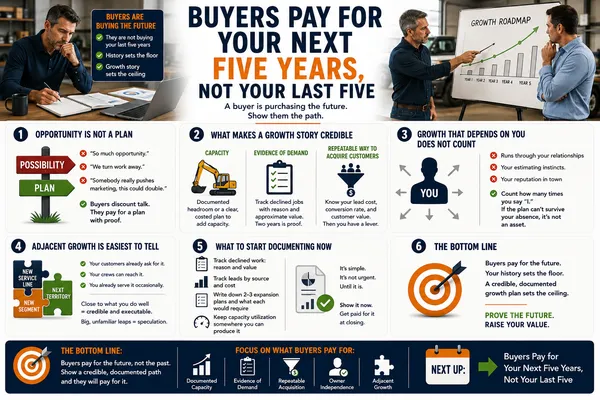
A buyer is purchasing the future. Your history is simply the most reliable evidence available about what that future looks like. It sets the floor on your price. What sets the ceiling is whether a buyer can see where the next several years of growth come from.
Opportunity is not a plan
Almost every owner I meet describes their growth potential the same way. There is so much opportunity in this market. We turn work away every week. If somebody really pushed marketing, this thing could double.
All of that may be true. It is also worth nothing at the closing table, because it describes a possibility rather than a path. A buyer hears the same speech from every seller they meet, and they have learned to discount it entirely.
The owners who get paid for growth potential are the ones who can answer a harder question: what specifically would the next owner do, and what evidence do you have that it works?
What makes a growth story credible
Three things, and you need all three.
First, capacity. If you are already at the ceiling of what your crews and equipment can deliver, growth requires investment the buyer has to fund on top of the purchase price. Documented headroom, or a clear and costed plan to add it, makes the story real.
Second, evidence of demand. Turning work away is the strongest evidence there is, but only if you tracked it. An owner who can show two years of logged declined jobs, with the revenue those jobs represented, has proof. An owner who says it from memory has an anecdote.
Third, a repeatable way to acquire customers. If growth depends on the phone ringing, a buyer has no lever to pull. If you can show what a lead costs, what share of leads convert, and what a customer is worth over time, then growth becomes a decision about how much to spend rather than a hope.
Growth that depends on you does not count
This is where growth potential and owner independence collide. If the plausible path to doubling runs through your relationships, your estimating instincts, or your reputation in town, then the buyer is not buying growth potential. They are buying a job that comes with a wish.
The test is simple. Describe your growth plan out loud, and count how many times you say I. If the plan cannot survive your absence, it is not an asset.
Adjacent growth is the easiest story to tell
The most believable growth stories are usually the least dramatic. A new service line your existing customers already ask for. A neighboring territory your crews could reach without a second location. A segment you serve occasionally and could serve deliberately.
These are credible precisely because they are close to what you already do well. A buyer can picture executing them. A plan to enter a market you have never served, using capabilities you do not have, reads as speculation no matter how large the number at the end.
What to start documenting now
Track declined work, including the reason and the approximate value. Track where leads come from and what each source costs. Write down the two or three expansions you would pursue if you were staying another five years, with what each would require. Keep capacity utilization somewhere you can produce it.
None of this is hard. It is just the kind of thing that never feels urgent until the year you go to market, and by then you are describing it from memory instead of showing it.
If you want help turning your growth story into something a buyer can verify, book a strategy session and we will build it out.
Book a complementary strategy session here!