Financial Performance: Why Clean Books Raise Your Price
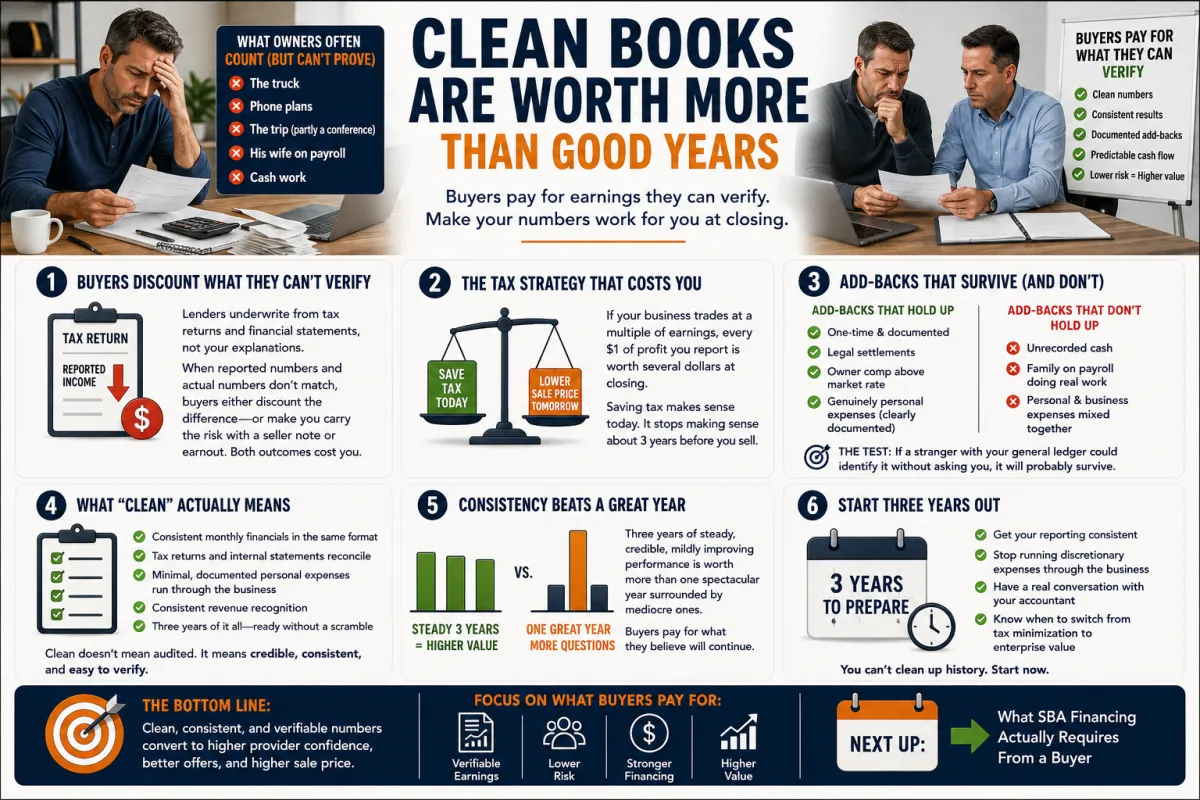
There is a conversation I have had more times than I can count. An owner tells me his business really makes far more than the tax return shows. Then he explains the truck, the phone plans, the trip that was partly a conference, his wife on payroll, and the work that came in as cash.
He is usually telling the truth. And he is usually about to lose real money at closing because of it.
Buyers discount what they cannot verify
A buyer is not being unreasonable when they refuse to pay for earnings you cannot document. They are being financed. Somewhere behind that buyer is a lender who will underwrite from tax returns and financial statements, not from your explanation of what the business really earns.
When your reported numbers and your actual numbers do not match, one of two things happens. Either the buyer discounts the difference entirely, or the deal gets structured so that you carry the risk of proving it, usually through a seller note or an earnout. Both outcomes cost you.
The tax strategy that costs you at the closing table
For years, minimizing taxable income was the smart play. Most owners were advised into it, and it worked, right up until the moment the business became the thing being sold.
Here is the arithmetic that surprises people. If your business trades at a multiple of earnings, every dollar of profit you legitimately report is worth several dollars of purchase price. Suppressing a dollar of profit to save a fraction of it in tax makes sense while you are operating. It stops making sense somewhere around three years before you sell, and most owners do not make the switch in time.
Add-backs that survive, and add-backs that do not
Add-backs are the legitimate mechanism for showing a buyer what the business truly earns. They also get abused, which is why buyers scrutinize them.
Add-backs that generally hold up are one time and documented: a legal settlement that will not recur, the owner's compensation above market rate for the role, a genuinely personal vehicle clearly identifiable in the records. Add-backs that fall apart are the ones that depend on your word: unrecorded cash, family members on payroll doing real work, or expenses that are personal and business in a proportion nobody can pin down.
The test is simple. If a stranger with your general ledger could identify the add-back without asking you a question, it will probably survive. If it requires your narration, expect a fight.
What clean actually means
Clean does not mean audited, and for most businesses in this range it does not need to. It means a few practical things.
Your financial statements are produced on a consistent basis, monthly, in the same format, by someone who knows what they are doing. Your tax returns and your internal statements reconcile to each other. Personal expenses run through the business are minimal, documented, and easy to isolate. Revenue recognition is consistent, so a buyer comparing your best year to your worst is comparing the same thing. And you can produce three years of all of it without a scramble.
Consistency beats a great year
Owners often try to time a sale to their best year. It is an understandable instinct and it is usually the wrong one, because a single outlier year invites the question of whether it repeats.
Three years of steady, credible, mildly improving performance is worth more than one spectacular year surrounded by mediocre ones. Buyers pay for what they believe will continue. Predictability is the product.
Start three years out
This is the driver with the longest lead time, because buyers look back three years and you cannot retroactively clean up history.
If a sale is anywhere in your thinking, the work starts now: get your reporting consistent, stop running what you can reasonably stop running through the business, and have a real conversation with your accountant about the tradeoff between tax minimization and enterprise value. Those two goals are in direct conflict, and only you can decide when to switch which one is winning.
If you are not sure how your financials will look to a buyer, book a strategy session and we will look at them the way one would.
Book a complementary strategy session, HERE