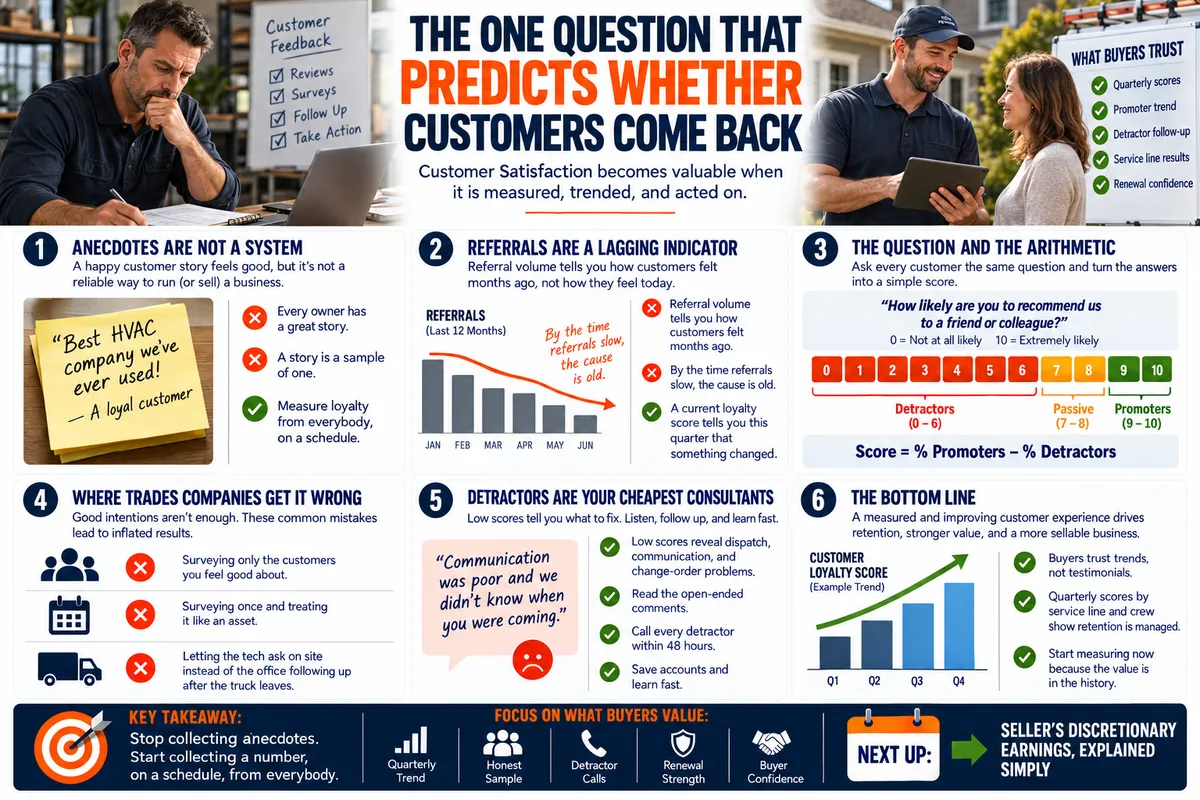
The One Question That Predicts Whether Customers Come Back
Ask an owner how his customers feel about the company and he will tell you about the lady on Sycamore who has used them for eleven years and sends everybody on her street.
That is a good story. It is also a sample of one, selected by the person with the most reason to select it. Every owner has that story, including the ones whose revenue is quietly leaking.
Value Driver 7 is Customer Satisfaction, and the shift it asks for is small but hard. Stop collecting anecdotes and start collecting a number, on a schedule, from everybody.
Referrals are a lagging indicator you cannot steer
Referral volume tells you how customers felt about work you did months or years ago. By the time referrals slow down, the cause is old and cold, and you are guessing about which crew, which season, or which process changed it.
A measured loyalty score moves faster. It tells you in the current quarter that something changed, and if you ask the right follow-up question, it tells you what.
The question and the arithmetic
The method most businesses use is simple. After a job closes, ask the customer how likely they are to recommend you to a friend or colleague, on a zero-to-ten scale, and then ask one open-ended question about why they chose that number.
Nines and tens are your promoters. Sevens and eights are lukewarm and will shop you next time. Anything six or below is a detractor who will either not call again or will tell people not to. Your score is the percentage of promoters minus the percentage of detractors.
The precise number matters less than the fact that it is the same number, measured the same way, every quarter. Buyers and lenders care about trends far more than about any single reading.
Where trades companies get this wrong
Three mistakes show up over and over. The first is surveying only the customers you feel good about, which produces a score that is worthless to you and transparent to a buyer.
The second is surveying once, getting a decent result, and framing it. A one-time survey is a snapshot. A quarterly rhythm is an asset.
The third is letting the tech ask for the review on site. A homeowner standing in her kitchen with your employee will not say the condenser install was mediocre. Send the survey from the office, after the truck leaves, and let people be honest.
Detractors are the cheapest consultants you will ever hire
The real value is not in the score. It is in the open-ended answers from the people who scored you low, because those comments will name your actual operational failures faster than any process audit.
In this industry the same themes surface constantly. "Nobody called to tell me the part was delayed." "The estimate did not match the invoice." "Three different guys came and I explained it three times." None of those are craftsmanship problems. They are dispatch, communication, and change-order problems, and every one of them is fixable.
Build a rule that every detractor gets a call from a human within forty-eight hours. You will save accounts, and you will learn more in those calls than in a year of staff meetings.
Why a buyer trusts a number and discounts a testimonial
A wall of five-star reviews tells a buyer that you have a review collection process. Two years of quarterly loyalty scores, segmented by service line and by crew, tells a buyer something entirely different: that customer retention here is managed rather than hoped for.
That matters most when a buyer is underwriting recurring revenue. If you are asking them to pay for four hundred service agreements, the first question is how many renew, and the second is what your customers actually think. A documented score answers both without argument.
Start measuring now, because the value is in the history, and history takes time to build. Next in the driver series we reach the last of the eight, and the one that costs owners more money than any other at the closing table.
If you want a loyalty measurement rhythm that a buyer will actually credit, book a strategy session and we will design one that fits how your crews already work.