How Much Cash Do You Really Need to Buy a Business?
This is the first question almost every buyer asks, and the answer they usually get is ten percent. That number is roughly right and badly incomplete, and the gap between the two is where first time buyers get into trouble.
The ten percent that is not ten percent
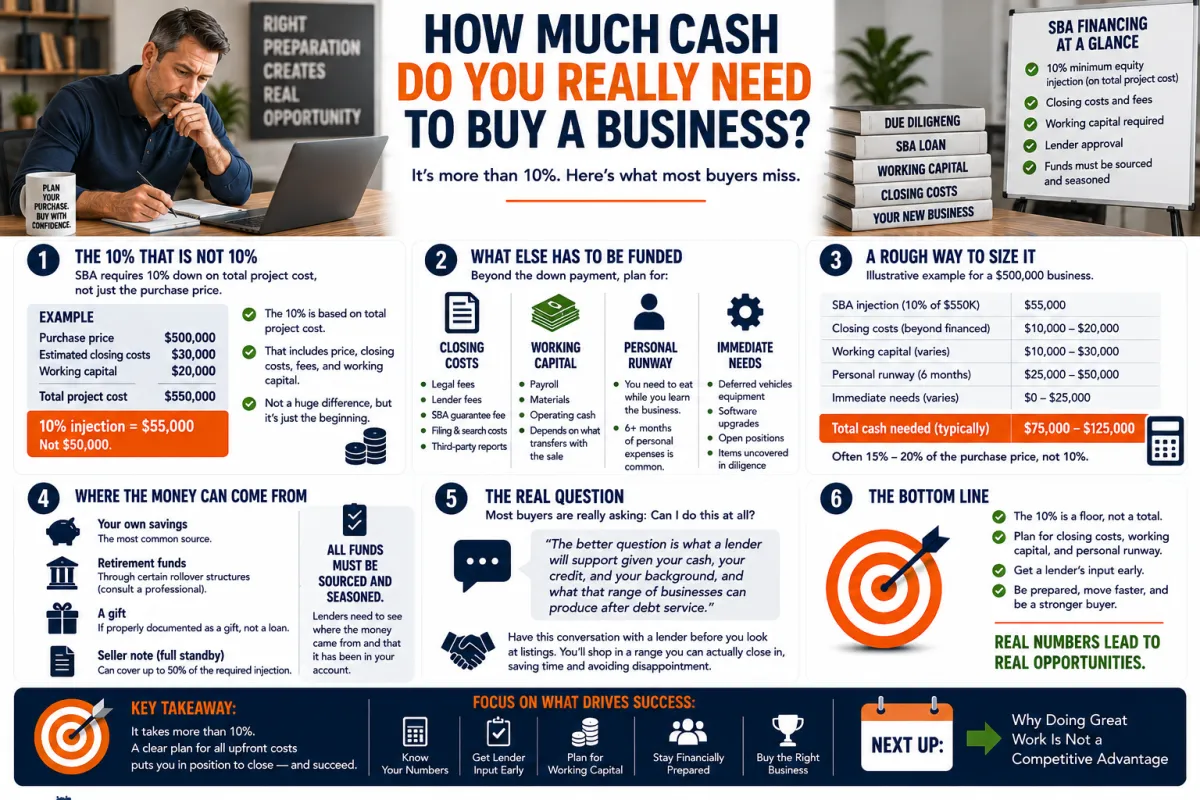
SBA rules require a minimum equity injection of ten percent for a complete change of ownership, calculated on total project cost rather than on the purchase price.
Total project cost includes the price of the business, closing costs, fees, and any working capital financed into the loan. So on a business listed at five hundred thousand, the project might total closer to five hundred and fifty, and ten percent of that is fifty-five thousand rather than fifty.
Not a catastrophic difference, but it is the first of several places the real number drifts above the one in your head.
What else has to be funded
Closing costs. Legal, lender fees, the SBA guarantee fee, filing and search costs, and any third party reports. Ask your lender for a written estimate early rather than discovering these in the final week.
Working capital. The business needs cash to operate from day one, and how much transfers with the sale is negotiated, not assumed. If the seller keeps the receivables, you are funding payroll and materials until your own collections start arriving. This surprises buyers more than any other item.
Personal runway. You need to eat while you learn the business. Owner compensation is usually part of the cash flow analysis, but the first months are rarely smooth, and a buyer with no personal cushion makes short term decisions that damage the business.
Immediate needs. Whatever the seller deferred. A truck at the end of its life, software that should have been replaced, a position that has been vacant. Diligence should surface these, and they belong in your budget rather than in your optimism.
A rough way to size it
As an illustration, not a quote. On a business priced at five hundred thousand, plan on roughly fifty-five thousand for the injection, ten to twenty thousand in closing costs beyond what gets financed, working capital that depends entirely on what transfers, and six months of personal expenses. Depending on the deal, real cash needed frequently lands between fifteen and twenty percent of the purchase price rather than ten.
Run your own numbers with a lender before you rely on any of that. The point is only that the injection is a floor, not a total.
Where the money can come from
Your own savings, obviously. Retirement funds through certain rollover structures, though the tradeoffs deserve a real conversation with a professional. A gift, if properly documented as a gift rather than a loan. A seller note on full standby can cover up to half of the required injection, which is one of the most useful tools available to buyers who are cash constrained but otherwise strong.
What matters as much as the source is documentation. Lenders require funds to be sourced and seasoned, meaning they can see where the money came from and that it has been sitting in your account rather than appearing the week before closing. Start assembling statements early.
The question behind the question
Most buyers asking how much cash they need are really asking whether they can do this at all.
The better framing is what a lender will support given your cash, your credit, and your background, and then what that range of businesses can produce after debt service. Answer that first and you shop in a range you can actually close in, which saves months.
Buyers who have that conversation before they look at listings move faster than buyers who fall for a business first and work backward. Sellers can tell the difference, and so can lenders.
If you want to know what your situation supports before you start looking, book a call and we will size it together and help you get preapproved!
Book a free strategy session today!