What a Business Is Worth vs What It Is Listed For
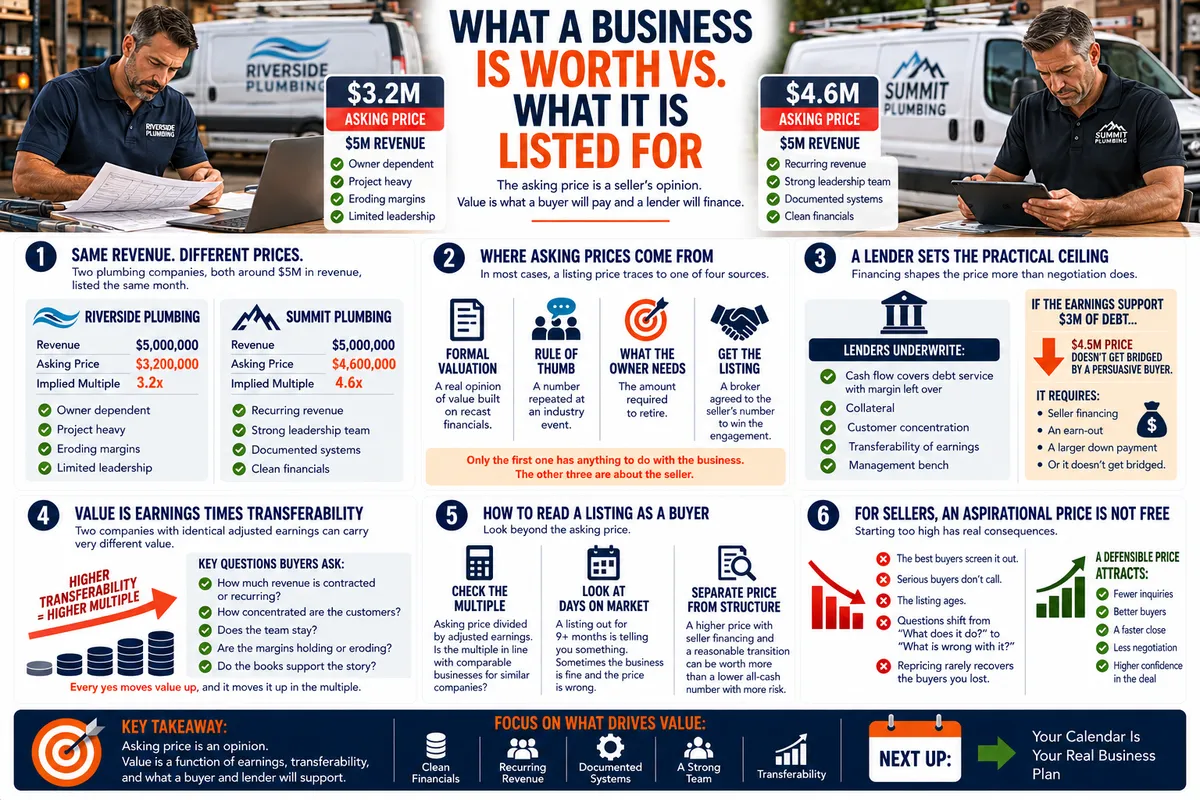
Two plumbing companies in the same metro, both around $5M in revenue, both listed the same month. One is asking $3.2M and the other is asking $4.6M. A buyer looks at the two listings and assumes the second one must be a better business.
Sometimes it is. Often the only difference is that the second owner picked a bigger number.
Asking price is an opinion held by a seller. Value is what a buyer will pay and a lender will finance. Those two things meet sometimes, and when they do not, the listing sits.
Where asking prices come from
In my experience, a listing price usually traces to one of four sources. A formal opinion of value built on recast financials. A rule of thumb somebody repeated at a trade association dinner. What the owner needs in order to retire. Or a broker who wanted the listing and agreed to the seller's number to get it.
Only the first one has anything to do with the business. The other three are about the seller, and buyers figure that out within one round of questions.
What a lender will finance sets the practical ceiling
For most transactions in this size range, financing shapes the price more than negotiation does. A bank underwrites whether the cash flow services the debt with margin left over, and it looks hard at collateral, customer concentration, and how transferable the earnings really are.
If a business generates enough adjusted earnings to cover debt service on $3M and the seller wants $4.5M, the gap does not get bridged by a persuasive buyer. It gets bridged by seller financing, an earn-out, a larger down payment, or it does not get bridged at all. Financing rules and lender appetite vary and change, so confirm specifics with your own lender and advisors. This is not legal or tax advice.
Value is earnings times transferability
Two companies with identical adjusted earnings do not carry identical value, and the difference is almost always about how much of the earnings survive the owner's departure.
The questions are consistent. How much of the revenue is contracted or recurring? How concentrated are the customers? Does the team stay? Are the margins holding or eroding? Do the books support the story without a month of reconstruction?
Every yes on that list moves value up, and it moves it up in the multiple, which is why the spread between a clean company and a messy one widens as earnings grow.
How to read a listing as a buyer
Start with the asking price divided by adjusted earnings, then ask what that implied multiple is buying. If the number is well above what comparable transferable businesses trade for, look for the justification, and be specific about wanting to see it rather than hear it.
Then look at days on market. A listing that has been out for nine months is telling you something the description is not. Sometimes the business is fine and the price is wrong, which can be the best situation a prepared buyer finds.
Finally, separate the price from the structure. A higher price with seller financing and a reasonable transition can be worth more to you than a lower all-cash number that comes with a wall of risk.
For sellers, an aspirational price is not free
Owners believe they can start high and come down. In practice, a price well above value burns the best buyers first. The serious ones, the ones with capital and experience, screen it out in ten minutes and never call.
Then the listing ages, and the questions change from "What does it do?" to "What is wrong with it?" Repricing a stale listing rarely recovers the buyers you lost.
A defensible price with the evidence behind it attracts fewer inquiries and better ones. That trade is almost always worth making, which raises the harder question of where your own number came from in the first place.
If you are weighing a listing or setting your own price, book a strategy session and we will separate the opinion from the evidence.