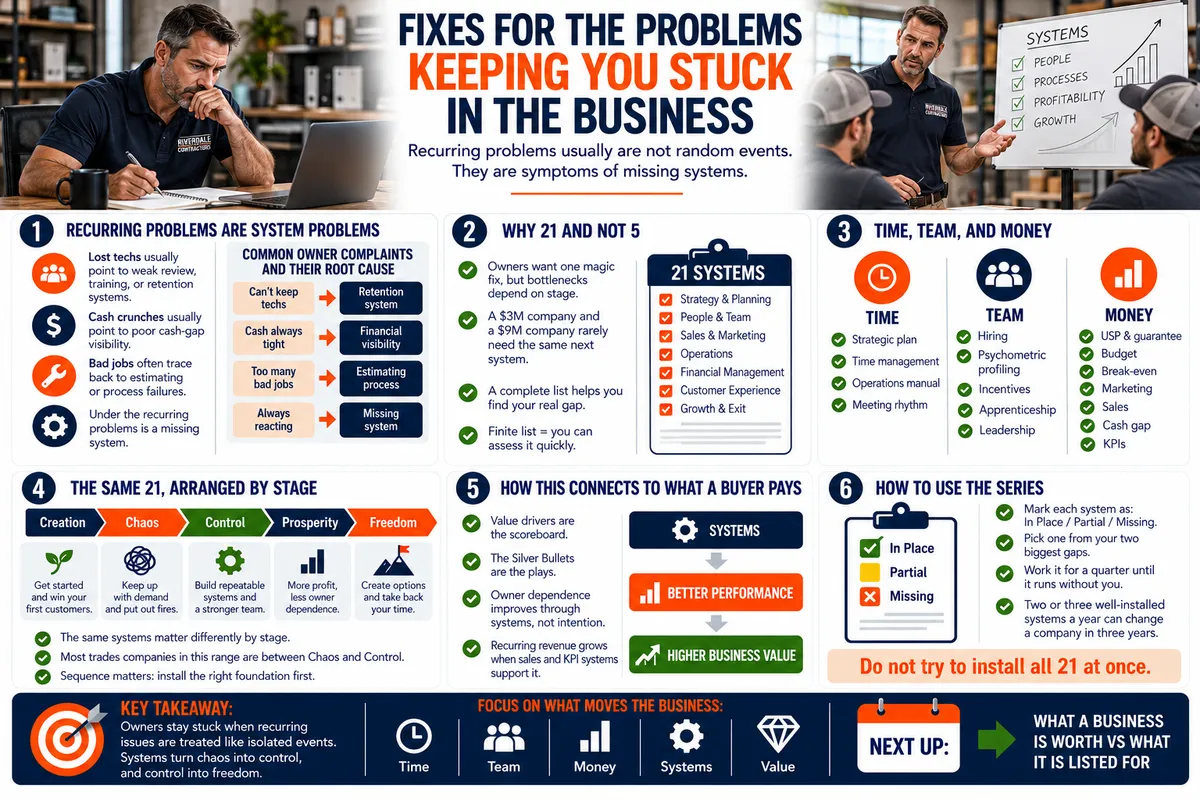
Fixes for the Problems Keeping You Stuck in the Business
Owners describe their problems as events. "We lost a great tech in July." "Cash got tight in February." "That commercial job went sideways and ate the quarter."
Run enough of those conversations and the events stop looking like events. The tech left because there was no clear path and no review rhythm. Cash got tight because nobody was watching the gap between paying for materials and getting paid for them. The job went sideways because the estimate was built on feel and there was no process to catch it.
Underneath nearly every recurring problem in a $3M to $10M trades business is a missing system. The 21 Silver Bullets are my working list of which systems those are. Over the coming months we will take them one at a time, applied to companies with trucks and crews.
Why twenty-one and not five
Every owner wants one thing: "Just tell me the one fix." I understand the impulse, and it is usually the wrong question, because the fix you need depends on what is already in place and what stage you are in.
A company doing $3M with no budget and no break-even number has a different bottleneck than a $9M company with solid financials and no bench of leaders. A complete list lets you find your actual gap instead of applying last year's popular advice to this year's problem.
The list is also deliberately finite. You can read it, mark what you have, and see what you do not, in about twenty minutes.
Time, Team, and Money
The simplest way I group them is by what they protect.
The Time group covers the systems that decide where your hours go and whether the work happens without you. That includes your strategic plan and current business plan, your time management plan, your operations and training manual, your meeting rhythm, your lean or process improvement program, your organizational plan, and your exit strategy. These are the systems that pull the owner out of the middle.
The Team group covers how you find, place, grow, and keep people. Team building, employee acquisition, psychometric profiling so you stop hiring on gut feel, performance incentives, apprenticeship, and leadership development. In the trades this group is usually the most neglected and the most expensive to neglect, because your capacity is your crews.
The Money group covers the systems that tell you the truth about the numbers. Your unique selling proposition and guarantee, which is what lets you price above the market, your revenue and profit budget, your break-even plan, your tactical marketing plan, your sales management system, your cash gap plan, and your KPI system. These are the ones that separate a busy company from a profitable one.
The same twenty-one, arranged by stage
There is a second way to read the list, and it is the one owners find more useful once they know where they stand. The same 21 map onto five stages of business: Creation, Chaos, Control, Prosperity, and Freedom.
That arrangement tells you the sequence. Installing a leadership development program before you have a budget or a break-even number is like framing a house before the foundation cures. The later systems are not wrong. They just will not hold.
Most trades companies in our range are somewhere between Chaos and Control. Revenue is real, the phone rings, and the owner is still the load-bearing wall. The systems that move you forward from there are mostly about measurement and authority, not about working harder.
How this connects to what a buyer pays
If you have been following the value driver posts, you already know what a buyer measures. The Silver Bullets are how those measurements get moved.
Owner dependence does not improve because you decide to delegate. It improves because there is an operations manual, a meeting rhythm, defined authority, and a leadership bench. Recurring revenue appears because a sales management system sells it and a KPI system tracks renewals. The drivers are the scoreboard. These are the plays.
How to use the series
Do not try to install all of them. That is the fastest way to install none of them.
Read the list, mark each one as in place, partial, or missing, then pick one from your two biggest gaps. Work it for a quarter until it runs without your attention, then pick the next. Two or three well-installed systems a year change a company completely in three years.
We start next week with one that sounds soft and is not, because it governs every other system on the list: what you actually do with your week.
If you want help figuring out which of the 21 is your real bottleneck right now, book a strategy session and we will score your company against the full list.